
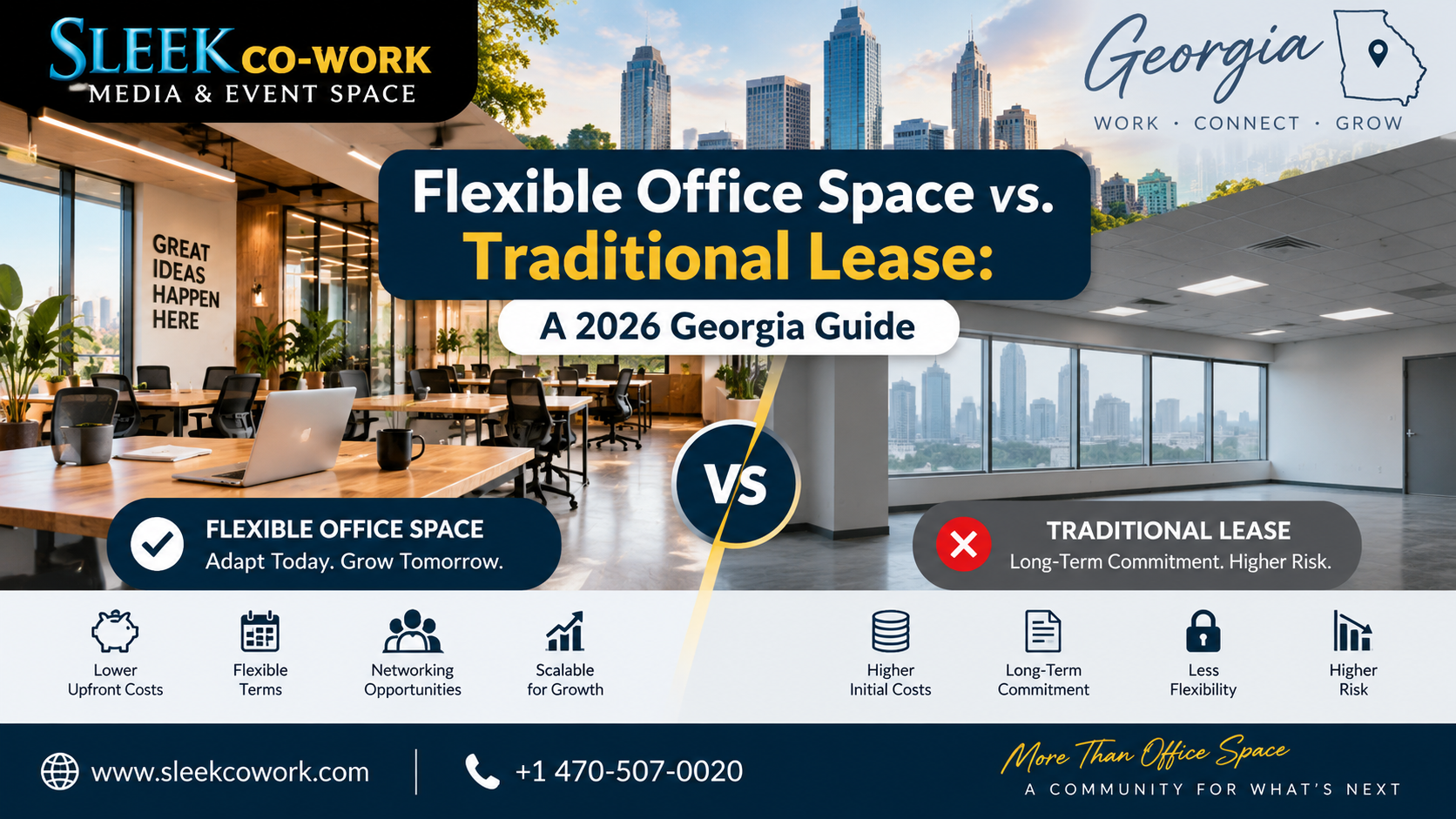
A traditional commercial lease in Georgia typically means a three to five year commitment, a security deposit, and responsibility for fit-out, furniture, internet, utilities, cleaning and insurance. Flexible office space bundles all of those into one monthly fee with terms measured in months rather than years. Traditional leases usually win on cost per square foot at scale; flexible space wins on total cost, speed and risk for teams under roughly 15 people or any business whose headcount is uncertain.
The office question has changed shape since 2020. It is no longer “how much space do we need” — it is “how much certainty do we actually have?”
For Georgia businesses weighing a commercial lease against flexible workspace in 2026, the honest answer depends less on your budget and more on your confidence about the next 36 months. Here is a straight comparison.
What a Traditional Commercial Lease Actually Involves
The advertised rate is rarely the real number. A conventional Georgia office lease typically brings the following:
- Term length. Commonly three to five years. Shorter terms exist but usually at a premium rate.
- Security deposit. Often several months of rent, held for the duration.
- Personal guarantee. Many landlords require one from small business owners, meaning your personal assets sit behind the lease.
- Fit-out and furniture. Desks, chairs, meeting furniture, partitions. This is a substantial upfront capital cost.
- Utilities and internet. Contracted separately, often with their own multi-year terms.
- Cleaning and maintenance. Either contracted or absorbed by your team.
- Insurance. Commercial liability and contents cover.
- Common area maintenance (CAM) charges. Frequently overlooked in early budgeting and can add meaningfully to the monthly figure.
- Dead space. You lease for peak occupancy, then pay for empty desks whenever anyone is remote, travelling or on leave.
Add these together and the true monthly cost of a traditional lease is routinely well above the headline rent.
What Flexible Office Space Includes
Flexible workspace consolidates the same functions into a single monthly cost with a short commitment.
- Furnished and ready. Desks, chairs and workspace already in place. No fit-out period, no capital outlay.
- Internet and utilities included. Enterprise-grade connectivity provided as standard.
- Cleaning and maintenance handled. Not your problem, not your line item.
- Meeting rooms on demand. Booked and paid for when needed rather than leased year-round for occasional use.
- Refreshments and shared amenities. Coffee, snacks, print facilities.
- Short commitment. Terms measured in months. Scale up or down as headcount changes.
- Immediate occupancy. Days rather than months from decision to working.
The Real Cost Comparison for a Small Georgia Team
Consider a five-person business.
Under a traditional lease, you might rent roughly 1,000 square feet, then add furniture, internet contracts, utilities, cleaning, insurance and CAM charges — plus a deposit and, in many cases, a personal guarantee, locked in for three years. The upfront capital cost alone frequently runs into five figures before anyone sits down.
Under a flexible arrangement, five memberships at a space like Sleek Cowork in McDonough — with all-access plans at $149 per month and business essentials plans including a business address at $179 per month — cover workspace, internet, utilities, cleaning, refreshments, and included conference room hours in one predictable monthly figure, with no fit-out and no multi-year exposure.
The traditional lease may eventually deliver a lower cost per square foot. The flexible option almost always delivers a lower cost of being wrong.
When a Traditional Lease Is Genuinely the Better Choice
Flexible space is not universally superior. A conventional lease makes clear sense when:
- You have 20 or more employees on site daily. At that scale, per-desk economics start favouring conventional space.
- You need specialised build-out. Labs, workshops, medical facilities, secure server rooms, heavy equipment.
- Your headcount is genuinely stable. Predictable growth over three to five years removes the main risk of a long term.
- Branding and signage matter commercially. Client-facing retail or professional practices where the premises are part of the offer.
- You need round-the-clock access. Shift operations or 24-hour requirements.
- You want the asset. Some businesses have strategic reasons to control their premises.
When Flexible Space Wins
- Teams under 15 people. The bundled economics are hard to beat.
- Uncertain growth. If you cannot confidently forecast headcount 24 months out, a three-year lease is a bet, not a plan.
- Hybrid teams. If people are in three days a week, a conventional lease means paying full-time for part-time occupancy.
- New market entry. Testing the Atlanta metro without committing capital.
- Project-based work. Temporary teams and fixed-duration contracts.
- Cash flow sensitivity. Operating expense beats capital expenditure when growth capital is scarce.
The 2026 Georgia Context
Two local factors matter for Georgia businesses right now.
First, hybrid work has stabilised rather than reversed, which means office demand is now driven by collaboration days rather than daily occupancy. Space leased for a full team that attends three days a week is space paid for and unused two days a week.
Second, growth in the southern crescent — Henry County in particular — has made suburban flexible space genuinely viable. Businesses that once had to choose between an Atlanta lease and working from home now have a third option close to where their staff actually live. For a McDonough or Stockbridge based team, that removes commute cost from the equation entirely.
How to Decide: Four Questions
- Can you confidently predict your headcount in 24 months? If no, take the shorter commitment.
- What percentage of desks would sit empty on an average day? Above 30% and flexible space almost certainly costs less in reality.
- What would the upfront capital buy instead? Fit-out money spent on hiring or marketing usually returns more.
- What happens if you need to exit early? Model the cost of breaking a three-year lease. That number is your real risk exposure.
If three of those four answers point the same way, you have your decision. Where they conflict, the tie-breaker is usually stage: businesses still finding their shape benefit more from optionality, while established businesses with predictable demand benefit more from committed cost.
Weighing your options for 2026? See flexible office space at Sleek Cowork in McDonough, GA — plans from $75 per month, no long-term lease. Call (470) 507-0020 to book a tour.
Frequently Asked Questions
Is flexible office space cheaper than a traditional lease in Georgia?
For teams under roughly 15 people, usually yes on a total-cost basis once furniture, internet, utilities, cleaning, insurance and CAM charges are included. Larger, stable teams often achieve a lower cost per square foot with a conventional lease.
How long is a typical commercial office lease in Georgia?
Three to five years is standard. Shorter terms are available but frequently carry a higher rate.
Can a flexible office be used as a registered business address?
Many flexible workspace providers offer a business address service. Sleek Cowork’s Business Essentials membership includes a business address and mailbox access at its McDonough location.
What are the hidden costs of a traditional office lease?
Fit-out and furniture, security deposit, CAM charges, utilities, internet contracts, cleaning, insurance, and the ongoing cost of desks that sit empty on hybrid days.
Can I scale flexible office space up and down?
Yes — that is the core advantage. Memberships can typically be added or removed as headcount changes, without renegotiating a lease.