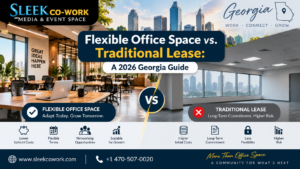


Coworking memberships save Georgia small businesses money in five main ways: they eliminate upfront fit-out and furniture costs, bundle utilities and internet into one fee, remove the cost of empty desks on hybrid days, replace year-round meeting room leases with pay-per-use booking, and cut the administrative overhead of managing a building. The largest saving is usually the one nobody budgets for — the cost of committing to space you end up not needing.
Most articles about coworking costs compare a membership fee to a rent figure and stop there. That comparison is close to meaningless, because rent is only one line in the cost of having an office.
Here is where the money actually goes for a Georgia small business, and what a coworking membership removes from that list.
1. Zero Upfront Capital
Before a traditional office generates a single dollar of value, it consumes capital. Desks, chairs, meeting furniture, monitors, partitions, signage, a coffee machine, network hardware, cabling, and often a fit-out to make the shell usable. For a small team, that regularly runs to five figures — spent before anyone has done a day’s work in the room.
Add a security deposit, typically several months of rent, and the capital sitting idle grows further.
A coworking membership requires none of it. The space is furnished, wired and working on day one. For a growing Georgia business, the meaningful saving is not just the amount — it is that the same capital can go into hiring, inventory or marketing, all of which generate revenue. Furniture does not.
2. One Bill Instead of Nine
A conventional office generates a stack of separate recurring costs, each with its own contract, renewal date and price increase:
- Electricity and water
- Internet, often on a multi-year business contract
- Cleaning services
- Commercial liability and contents insurance
- Common area maintenance charges
- Waste collection
- Coffee, water and kitchen supplies
- Printer leases, toner and paper
- Security and alarm monitoring
A coworking membership consolidates these into a single predictable monthly figure. The direct saving comes from shared infrastructure — you are splitting an enterprise-grade internet connection and a commercial cleaning contract across dozens of members rather than carrying it alone.
The indirect saving is arguably bigger: nobody on your team spends time chasing a utilities provider, renegotiating a printer lease, or discovering that your internet contract auto-renewed at a higher rate. For a small business, owner time is the most expensive resource there is.
3. You Stop Paying for Empty Desks
This is the largest hidden cost in post-2020 office economics and the one businesses most consistently underestimate.
A traditional lease is sized for peak occupancy. You lease for everyone, then pay for that space 100% of the time regardless of who is actually in. If your team works hybrid three days a week, roughly 40% of your office cost is paying for empty chairs. Add annual leave, sick days, client visits and travel, and the utilisation figure drops further.
With a flexible workspace, you pay per person for access rather than per square foot for a footprint. A five-person team on hybrid schedules can hold five memberships and use them when needed, rather than leasing 1,000 square feet that sits half empty most days.
For many Georgia small businesses this single factor makes coworking cheaper in absolute terms, not merely more convenient.
4. Meeting Rooms Become a Variable Cost
A conference room in a leased office is a permanent cost for occasional use. You pay rent on that square footage every month of the year, and most small businesses use it a handful of times a month. It is expensive storage the rest of the time.
Coworking converts that fixed cost to a variable one. You book a room when you have a client presentation or a team session and pay only for those hours. Many memberships include a monthly allowance — at Sleek Cowork in McDonough, for example, All Access and Business Essentials memberships include four hours of conference room time per month, with additional hours bookable as needed.
The same principle applies to specialist facilities. A soundproof content room or a media studio would be unthinkable to build into a small business’s own premises. Shared across a coworking community, it becomes available at an hourly rate.
5. Reduced Risk, Which Is a Real Financial Saving
Risk does not appear on a profit and loss statement, which is why it gets ignored — but it is where the largest losses actually occur.
A three-year Georgia commercial lease is a substantial committed liability, frequently backed by a personal guarantee. If your business contracts, loses a major client, or simply grows in a different direction, that obligation continues. Exiting early typically means paying out the remainder, finding a subtenant, or negotiating a settlement — all expensive, all distracting.
A month-to-month or short-term membership caps that exposure to a single billing period. You can scale down in a difficult quarter and scale back up when things improve, without a lawyer or a landlord conversation.
For a business owner, the ability to be wrong cheaply is worth real money — and it is the reason many Georgia founders now treat workspace as an operating expense to be adjusted rather than a fixed commitment to be endured.
Bonus: The Costs Coworking Adds That Are Worth Paying
An honest article should note what coworking is not. It does not give you a branded reception with your logo on the wall. It does not give you unlimited private space at low cost as you scale past 15 or 20 people. It does not suit businesses needing specialised build-out.
What it does add is access to things a small business could not otherwise justify — a 22-seat conference room, a media studio, an events programme, and a network of other business owners. Those are not cost savings. They are capability you would not otherwise have, included in a price you were going to spend on a worse office anyway.
Want to see the numbers for your own business? Compare Sleek Cowork membership plans in McDonough, GA from $75 per month — or call (470) 507-0020 to talk through what fits your team.
Frequently Asked Questions
Is coworking actually cheaper than renting an office in Georgia?
For most businesses under about 15 people, yes on a total-cost basis once furniture, deposits, utilities, internet, cleaning, insurance, CAM charges and unused desk time are included. Larger stable teams may achieve a better rate with a conventional lease.
What does a coworking membership include in McDonough, GA?
At Sleek Cowork, memberships include workspace access, enterprise-grade internet, complimentary coffee, tea and snacks, daily printing, conference room hours depending on plan, and access to community events. Plans start at $75 per month.
Can a small team share a coworking space cost-effectively?
Yes — teams typically hold individual memberships, which means you pay per person actually using the space rather than for a fixed footprint sized to peak occupancy.
Is a coworking membership a deductible business expense?
A workspace used for business is generally treated as an ordinary and necessary business expense. Confirm your specific circumstances with a licensed CPA.
What is the biggest hidden cost of a traditional office lease?
Empty desks. A lease sized for full occupancy but used on a hybrid schedule means paying full price for partial use, every month, for the length of the term.